Foundation repair cost · Houston
Foundation Repair Cost in Houston (2026): Piers, Permits and Beaumont Clay
Short answer
Foundation repair in Houston averages $5,003, with most homeowners paying $3,276–$6,729 (Angi, Oct 2025). Piering — the usual fix for a settling slab on Houston clay — runs $2,100–$7,700 per job in Angi's Houston data, slab-jacking $1,100–$3,100, and pier-and-beam repairs $990–$15,500. Larger jobs with many piers go well beyond the average; HomeAdvisor puts settling or sinking foundations at $5,000–$25,000 nationally.
In this guide
Quick Facts
| Detail | Figure | Source |
|---|---|---|
| Houston average | $5,003 | Angi, Oct 2025 |
| Typical Houston range | $3,276–$6,729 | Angi, Oct 2025 |
| 1,500 sq ft home | $3,000–$10,500 | Angi, Oct 2025 |
| Piering | $2,100–$7,700 | Angi, Oct 2025 |
| Slab-jacking | $1,100–$3,100 | Angi, Oct 2025 |
| Pier and beam repair | $990–$15,500 | Angi, Oct 2025 |
| Structural engineer report | $340–$780 | HomeAdvisor, Jun 2026 |
| City permit admin fee | $33.56 | Houston Permitting Center |
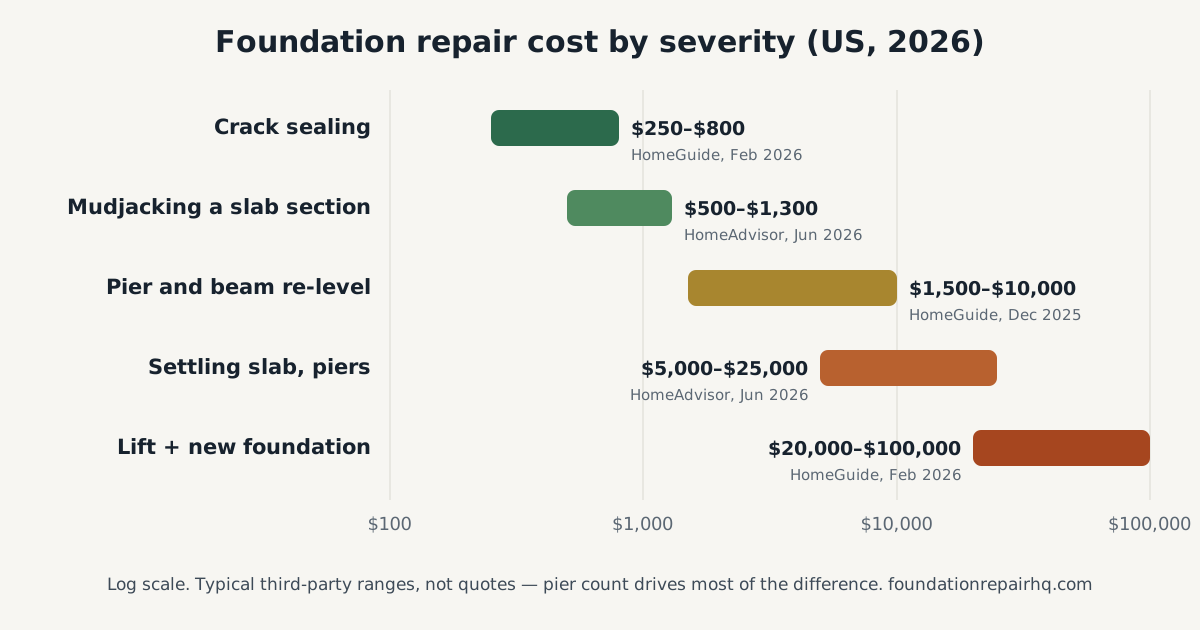
Houston Foundation Repair Cost by Method
| Repair | Houston figure | What it is |
|---|---|---|
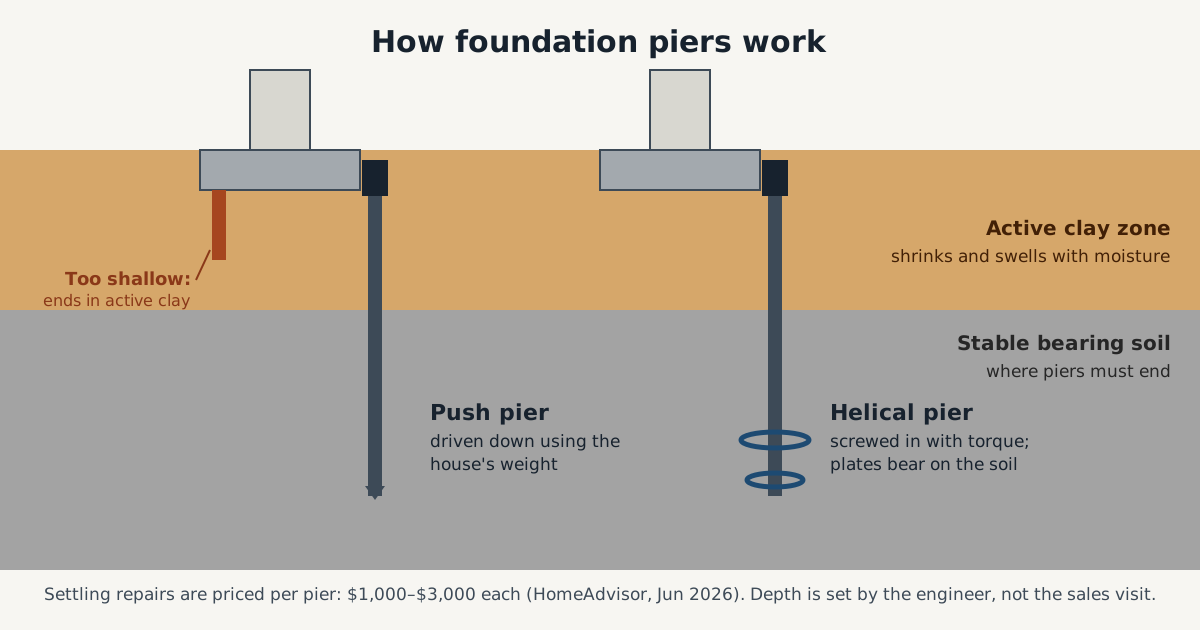
| Piering (slab) | $2,100–$7,700 (Angi, Oct 2025) | Piers driven or drilled under the slab perimeter and lifted to level. Per-unit pricing for settling repairs runs $1,000–$3,000 (HomeAdvisor, Jun 2026). |
| Slab-jacking | $1,100–$3,100 (Angi, Oct 2025) | Grout or foam pumped under sunken slab sections. Lifts concrete; does not stop deep soil movement. |
| Pier and beam | $990–$15,500 (Angi, Oct 2025) | Shimming, pier replacement and beam work under raised houses. HomeGuide lists $1,500–$10,000 to shim and level (Dec 2025). |
| Crack repair only | $250–$800 (HomeGuide, Feb 2026) | Sealing a non-structural crack. Right when the slab isn't moving. |
| Drainage correction | Gutters $2,200–$5,000 · regrading $1,000–$3,000 · French drain $1,200–$4,500 (HomeGuide, Dec 2025) | Keeps moisture around the slab even — often part of a lasting fix. |
Swipe the table sideways to see every column.
The number that matters most on a Houston quote is how many piers and how deep. Ask for the engineer's pier plan and a per-pier price so you can compare bids line by line.
Why Houston Foundations Move
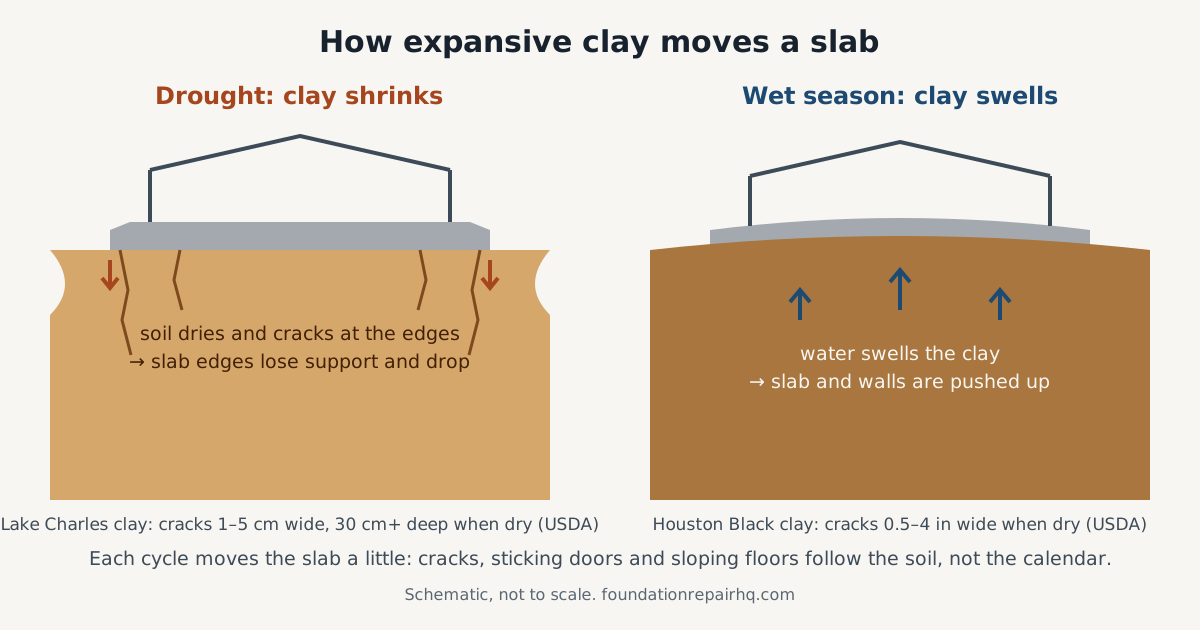
Beaumont and Lake Charles clays. A large part of Houston sits on clays formed on the Beaumont Formation. USDA describes the Lake Charles series as 45–60% clay that, when dry, cracks "1 to 5 cm wide" to a depth of 30 cm or more; the Beaumont series is 42–60% clay with dry cracks 30 cm or more deep. These soils swell when wet and shrink when dry, and a slab poured on them rides that movement.
Drought, then rain. In August 2023 the City of Houston averaged 91.0°F — its warmest month on record — with 0.01 inches of rain, and the whole region was in at least extreme drought (NWS Houston/Galveston). Summers like that pull moisture out from under the slab edges; the cracks and sticking doors often show up weeks later, and some close again after the soil re-wets.
Subsidence. Parts of the Houston–Galveston region have sunk over decades because of groundwater withdrawal (Harris-Galveston Subsidence District). Regional subsidence is slow and uniform enough that it rarely shows up as a single-house foundation problem, but it matters for drainage and flooding.
Permits and Engineers in Houston
The Houston Permitting Center lists foundation repair as its own permit type, covering "the repair of the fractures in slabs" and "stabilizing a structure that has moved". The page describes plan review plus pre-construction and final inspections. For slab-on-grade repairs it asks for plans by a Texas-licensed engineer showing the "location, quantity, and type of supports - piers or pressed piles"; level-and-shim work on raised houses uses a repair-per-spec list. The listed admin fee is $33.56, processing takes 1–5 business days and the permit is valid for 180 days. Confirm with the Permitting Center for your address.
In practice that means a reputable Houston job includes an engineer's pier plan before work and an engineer's letter after — the paperwork buyers and their inspectors ask for when you sell.
Plumbing Leaks, Insurance and Your Slab
Houston slabs carry the house's plumbing. A leak under the slab can wash out or swell the soil and cause the same cracks as drought. That matters for insurance: the Texas Department of Insurance's consumer guide lists earth movement among the things policies typically don't cover, but TDI requires insurers on the standard ISO forms to offer a Foundation Coverage–Texas endorsement for foundation damage caused by leakage from a plumbing system, capped at 15% of dwelling coverage (TDI Order 02-0741). If a leak is suspected, have the plumbing tested before the foundation is repaired, and check your policy for the endorsement.
When You Don't Need Repair
Hairline slab cracks, a door that sticks only in late summer, and drywall tape cracks after a drought are common in Houston and often aren't structural. If cracks aren't widening and floors aren't measurably out of level, start with monitoring the crack, even watering around the slab and fixing gutters. See why Houston piers fail and how deep they should go before you compare pier bids.
What To Do Next
- Document cracks, door gaps and floor slope with dated photos.
- Rule out a plumbing leak if water bills or warm floor spots suggest one.
- Get an engineer's evaluation and pier plan for slab movement.
- Compare quotes on pier count, depth, method, warranty and permit.
Frequently Asked Questions
How much does foundation repair cost in Houston? Angi's Houston data puts the average at $5,003, with a typical range of $3,276–$6,729 and $3,000–$10,500 for a 1,500-square-foot home (Oct 2025). Piering runs $2,100–$7,700; larger jobs with many piers cost more.
Do I need a permit for foundation repair in Houston? The Houston Permitting Center lists foundation repair as a permit type with plan review and inspections, and asks for engineer-prepared plans for slab-on-grade repairs. The listed admin fee is $33.56; confirm requirements for your address.
Why do Houston foundations crack so often? Much of Houston sits on Beaumont and Lake Charles clays that are 42–60% clay and crack deeply when dry (USDA NRCS). Drought summers like August 2023 shrink the soil under slab edges; heavy rain swells it again.
Does homeowners insurance cover foundation repair in Houston? Ordinary settlement and earth movement are typically excluded. Damage caused by a plumbing leak can be covered if your policy has the Foundation Coverage–Texas endorsement, which insurers on ISO forms must offer (TDI).
Should I hire a structural engineer before a foundation contractor in Houston? For slab movement, yes. An engineer's report costs $340–$780 (HomeAdvisor, Jun 2026) and gives you an independent pier plan, which Houston's permit process asks for anyway.
Get a Professional Assessment
A Houston quote is only as good as the measurements behind it. A free inspection tells you whether you need piers, how many, and whether something simpler will do.
Sources
11 references
Cost ranges are third-party figures with the publisher and date named. They are not quotes; your price depends on an on-site assessment.
- 01Angi — Foundation repair cost in Houston, TXangi.comupdated Oct 10, 2025
- 02HomeAdvisor — Foundation repair cost (US)homeadvisor.comupdated Jun 20, 2026
- 03HomeGuide — Foundation repair costhomeguide.comFeb 6, 2026
- 04HomeGuide — Pier and beam foundation repair costhomeguide.comDec 19, 2025
- 05Houston Permitting Center — Foundation repair permithoustonpermittingcenter.org
- 06USDA NRCS — Official Series Description, Lake Charlessoilseries.sc.egov.usda.govrev. 03/2016
- 07USDA NRCS — Official Series Description, Beaumontsoilseries.sc.egov.usda.govrev. 07/2014
- 08NWS Houston/Galveston — August 2023 regional climate summaryweather.gov
- 09Texas Department of Insurance — Commissioner's Order 02-0741 (Foundation Coverage–Texas endorsement)tdi.texas.govJul 18, 2002
- 10Texas Department of Insurance — Home insurance guidetdi.texas.govupdated Jun 1, 2026
- 11Harris-Galveston Subsidence District — Subsidence FAQshgsubsidence.org
Local soil and housing data
USDA soil, NOAA climate and Census housing figures for each city.