Costs & Estimates
Foundation Crack Repair: Epoxy vs. Polyurethane Injection, Kits and Cost
Short answer
Repairing a non-structural foundation crack costs $250–$800 per crack with epoxy or polyurethane injection (Angi, Dec 2025). Epoxy is the structural choice for dry, stable cracks under 1/4 inch; polyurethane is the water-stopping choice for wet or slightly moving cracks. If the crack is wider than 1/2 inch, displaced, or growing, injection only hides a settlement problem — structural crack repair ranges from $1,000 to $30,000+ (HomeGuide, 2026) because the real fix is under the foundation.
In this guide
Quick Facts
| Detail | Info |
|---|---|
| Most common cause | Concrete shrinkage during curing, or soil movement under the footing |
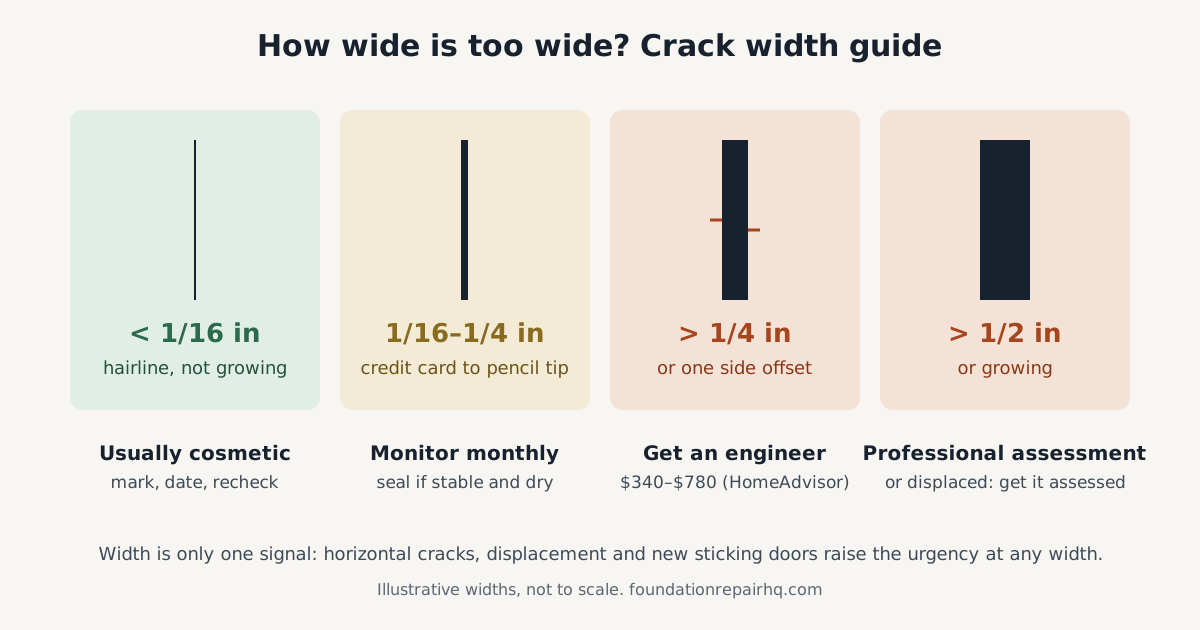
| Serious if | Wider than 1/2 inch, offset on one side, horizontal in a block wall, or growing month to month |
| Typical repair cost | $250–$800 per non-structural crack (Angi, Dec 2025) |
| Typical repair method | Epoxy injection (dry, stable) or polyurethane injection (wet, active) |
| DIY appropriate? | Yes for a dry hairline crack under 1/8 inch that isn't changing; no for anything leaking or widening |
| Source | Angi Dec 2025; HomeGuide 2026; |
How Do I Repair a Crack in My Foundation?
You're looking at a thin line in the basement wall or garage slab — maybe it has a little white powder along it, maybe it darkens after rain. You can slide a credit card into one end but not the other. It has probably been there longer than you noticed it.
Before choosing a product, answer three questions with a ruler and a pencil: how wide is it, is one side higher than the other, and is it wet? Those three answers decide the method — and whether a crack repair is the repair at all.
Epoxy vs. Polyurethane Injection
| Epoxy injection | Polyurethane injection | |
|---|---|---|
| What it does | Bonds the concrete back together; restores strength | Expands to fill the crack and stop water |
| Best for | Dry, stable cracks under 1/4 inch | Wet, leaking or slightly moving cracks |
| Strength | Rigid; around 12,000 PSI compressive (A-Tech 212 LV) | Flexible; expands up to 20:1 |
| Temperature | Needs the wall above 50°F | Works down to 40°F |
| Typical cost | $250–$800 per crack (Angi, Dec 2025) | $250–$800 per crack (Angi, Dec 2025) |
Swipe the table sideways to see every column.
DIY injection kits use the same chemistry with surface ports and a caulk-gun cartridge. They work on a dry, stable hairline crack in a poured wall; they don't work on block walls, on cracks that are actively leaking under pressure, or on cracks that are still moving.
Foundation Crack Sealant: Types and When Each Works
| Sealant type | What it is | Works for | Fails when |
|---|---|---|---|
| Epoxy injection | Rigid resin pumped into the crack through ports | Dry, stable cracks under 1/4 inch; restores strength (about 12,000 PSI compressive, A-Tech 212 LV) | The crack is wet or still moving; wall below 50°F |
| Polyurethane injection | Foam resin that expands up to 20:1 to fill the crack | Wet, leaking or slightly moving cracks; works to 40°F | The crack is wider than the foam can bridge, or the wall is still settling |
| Hydraulic cement | Fast-setting cement pressed into the crack face | Plugging an actively dripping crack as a stopgap | The crack moves — rigid cement cracks again beside the patch |
| Flexible caulk / polyurethane sealant | Gun-applied bead on the surface | Cosmetic hairline cracks, slab and control joints | Water pushes from behind; it seals only the surface, not the depth of the crack |
| Rubberized spray or masonry waterproofing paint | Surface coatings such as rubber sprays or Drylok | Damp walls from vapor; Drylok Extreme is rated to 15 PSI | Sustained hydrostatic pressure from outside lifts and blisters the coating |
Swipe the table sideways to see every column.
A surface sealant fails for the same few reasons almost every time:
- Water pressure from outside: 10 feet of saturated soil puts about 600 pounds per square foot against the wall, and a coating bonded only to the inside face is pushed off.
- Shallow fill: a bead or coating bridges the crack at the surface while water still travels through the crack behind it and exits at the edge of the patch.
- Movement: a crack that is still opening tears rigid patches and stretches thin coatings.
- Bad conditions: sealant applied to a damp, dusty or efflorescence-covered surface won't bond, and poor environmental conditions cause 40% of injection failures (ICRI); 60–80°F is ideal.
Injection is the only sealant method that fills the crack through the full wall thickness. Surface products are fine for cosmetic cracks and slab joints, not for a basement crack that leaks under pressure.
Why This Happens
- Curing shrinkage: poured walls contract as they dry and crack vertically, usually within the first year.
- Soil movement: expansive clay shrinks under part of the footing and that section drops, cracking the wall at a weak point.
- Lateral pressure: saturated soil pushes a block or poured wall inward and cracks it horizontally.
- Water: hydrostatic pressure turns a dry hairline crack into a leaking one and reopens cracks sealed only at the surface.
Concrete shrinks as it cures, and a poured wall that is restrained by its footing relieves that stress by cracking — usually vertically and within the first year. That kind of crack is cosmetic. Soil movement is different: expansive clay shrinks under part of the footing, that section drops, and the wall above cracks at the weak point — often wider at one end, offset, or stair-stepping through block joints. Cracks wider than 1/2 inch call for a professional assessment because the crack is reporting movement, not just shrinkage.
What To Do Next
- Free: mark both ends of the crack with a pencil and the date, measure the width with a coin or crack gauge, and photograph it next to a ruler.
- Free: re-check monthly for three months. No change = shrinkage; seal it.
- $250–$800: have a dry stable crack epoxy-injected, or a leaking one polyurethane-injected (Angi, Dec 2025).
- $340–$780: if it is growing, offset or wider than 1/2 inch, get a structural engineer's evaluation first (HomeAdvisor, Jun 2026) — injection won't stop settlement.
Cost by severity
- Hairline, dry, stable: $0 to monitor; $60–$90 for a DIY epoxy kit (A-Tech 212 LV) if you want it sealed.
- Non-structural crack, professionally injected: $250–$800 per crack (Angi, Dec 2025).
- Engineer's evaluation for a growing or offset crack: $340–$780 (HomeAdvisor, Jun 2026).
- Structural crack repair where the foundation moved: $1,000–$30,000+ (HomeGuide, 2026).
When You Don't Need Repair
A vertical hairline crack in a poured wall, under 1/16 inch, unchanged for six months, dry, with no sticking doors or sloping floors above it is almost certainly shrinkage. It doesn't need injection to be safe. Save your money: seal it only if it lets in water or bothers you, and keep the dated photo for when you sell.
Related Issues to Check
- White powder along the crack. Efflorescence means water is passing through the concrete, which points to the polyurethane option and to drainage outside the wall.
- Sloping floors in the rooms above. A crack plus a measurable floor slope means the footing has moved, and the repair is piers, not injection.
- Water pushing up through the slab. Hydrostatic pressure under a basement floor reopens injected cracks unless the water is relieved with drainage.
Frequently Asked Questions
How much does it cost to fix a crack in a foundation? $250–$800 per non-structural crack with epoxy or polyurethane injection (Angi, Dec 2025). Structural crack repair — where the foundation has moved — ranges from $1,000 to $30,000+ because it usually means piers (HomeGuide, 2026).
Is epoxy or polyurethane better for foundation cracks? Epoxy for dry, stable cracks you want to bond structurally; polyurethane for wet or slightly moving cracks you need to seal against water. Epoxy needs the wall above 50°F; polyurethane works to 40°F.
Do foundation crack repair kits work? Yes, on a dry, stable hairline crack in a poured concrete wall. They don't fix leaking cracks under pressure, block walls, or cracks that are still moving.
Can Flex Seal fix foundation cracks? Not reliably. Rubberized spray coatings like Flex Seal bond to the surface only, so on a basement crack that leaks under water pressure from outside, the water pushes the coating off or travels around it. They can cover a dry cosmetic crack, but for a leaking basement crack, polyurethane injection ($250–$800, Angi, Dec 2025) fills the crack through the full wall thickness and is the fix that lasts.
What is the best sealant for foundation cracks? It depends on the crack: epoxy injection is best for a dry, stable crack under 1/4 inch because it bonds the concrete back together, and polyurethane injection is best for a wet or slightly moving crack because it expands and stays flexible. Hydraulic cement is a short-term plug for an actively dripping crack, and flexible caulk is only for cosmetic cracks and slab joints. No sealant fixes a crack that is still growing — that needs an engineer's diagnosis.
Can you seal a foundation crack from the inside? Yes — most poured-wall cracks are sealed from the inside by injection, which pushes epoxy or polyurethane through the full depth of the crack to the soil side without digging. Surface sealants applied inside are different: they fail under water pressure from outside. Exterior repair, which means excavating to the footing, is needed only when interior injection has failed, the wall needs exterior waterproofing ($10,000–$15,000+, HomeGuide, 2026), or the wall must be dug out and straightened.
When is a foundation crack too big to inject? When it is wider than 1/2 inch, offset, horizontal in a block wall, or growing. At that point the crack is a symptom of movement and needs an engineer's assessment, not a sealant.
Get a Professional Assessment
If your crack is changing, the question isn't which sealant — it's what moved. A free inspection tells you which kind of crack you have.
Last reviewed: October 2026 · Sources verified against current industry data
Sources
3 references
Cost ranges are third-party figures with the publisher and date named. They are not quotes; your price depends on an on-site assessment.
- 01Angiangi.com2025
- 02HomeGuidehomeguide.com2026
- 03HomeAdvisorhomeadvisor.com2026
Foundation repair near you
Local soil and typical cost ranges for cities where this comes up most.