Diagnosing Problems
Sagging Floors: Causes, When to Worry, and What Repair Costs
Short answer
A sagging floor is a floor that dips between its supports. The joists, the girder that carries them, or the posts under the girder have bent, rotted or settled, so the floor is low in the middle and still level at the walls. That is a framing problem, usually fixed from the crawl space or basement. It is different from a sloping floor, where the whole floor plane tilts because the foundation moved. Typical sagging floor repairs cost $1,000–$8,500, with sistering at $150–$325 per joist and main beam replacement at $2,000–$10,000 (Fixr, Sep 2026).
In this guide
Quick Facts
| Detail | Info |
|---|---|
| Most common cause | Crawl space or basement moisture rotting joists and sills, settled or rotted support posts, or joists overspanned or cut for plumbing |
| Serious if | The dip is getting deeper, wood is soft when probed, posts lean or no longer touch the beam, or the sag sits under a heavy load like a tub, piano or kitchen island |
| Typical repair cost | $1,000–$8,500 typical; sistering $150–$325 per joist; joist replacement $500–$2,500 per joist (Fixr, Sep 2026) |
| Typical repair method | Sistering joists, adding a beam or adjustable steel posts on footings, and fixing the moisture that caused the rot |
| DIY appropriate? | Inspection and measuring, yes; sistering a single dry, uncut joist is possible for an experienced DIYer; jacking a girder, no |
| Source | Fixr Sep 2026; HomeGuide Dec 2025; HomeAdvisor Jun 2026 |
When Should I Worry About Sagging Floors?
You notice it walking across the room. The floor feels like it drops slightly as you reach the middle, then rises again toward the far wall. Furniture in the center of the room rocks, while pieces against the walls sit flat. A marble set down near a wall rolls toward the center of the room and stops there.
From below, if you have a crawl space or an unfinished basement, the dip is often visible. Look along the bottom edge of the joists toward a flashlight held at the far end. A row of joists that curves down in the middle, a girder with a belly between two posts, or a post with a gap at the top all show where support has been lost. Dark staining, white fuzzy growth or wood that crumbles at the sill plate point to moisture.
Timing tells you a lot. A dip that has been the same since you bought the house is often how it was framed. A dip that is new, deeper than last year, or showed up after a plumbing leak or a wet winter in the crawl space is active and worth a closer look.
Sagging vs. Sloping Floors: How to Tell Them Apart
The two get confused all the time, and they lead to different repairs at different prices.
| Sagging floor | Sloping floor | |
|---|---|---|
| Shape | A dip: low in the middle, level at the walls | A tilt: the whole room runs downhill one way |
| String test | A string pulled tight wall to wall shows the biggest gap at mid-room | The gap grows steadily from one wall to the other |
| Next room | Usually stops at the walls or beam line | Often continues into adjacent rooms in the same direction |
| Where the problem is | Joists, girder, posts, sill plate | Soil and foundation under that side of the house |
| Typical fix | Sister joists, add posts or a beam, fix moisture | Piers under the settled section or re-leveling the foundation |
Swipe the table sideways to see every column.
The string test (free, 10 minutes): pull a string tight across the floor from one baseboard to the opposite one, raised on two equal blocks at each end. Measure from the string down to the floor every 2 feet. A sag gives you the largest measurement in the middle. A slope gives you numbers that keep growing toward one wall. Run a second string at right angles to see whether the dip follows the joists. If your numbers say slope, the right page is sloping or uneven floors. If the floor flexes when you walk but has no lasting dip, that's covered in bouncy floors.
Why This Happens
A floor sags when the wood carrying it has lost strength or lost the support under it.
- Support is lost under the framing. A post sinks into soft crawl-space soil, a wood shim compresses, or a sill plate rots on top of the foundation wall. Decay fungi need wood above the fiber saturation point, about 30% moisture content, while air-dried wood at no more than 20% doesn't decay (USDA Forest Products Laboratory, 2005). Wet crawl-space soil and leaks push framing into that range.
- The joists now span farther than designed. When a mid-span post or girder drops, the joists above it have to bridge the gap on their own. Code designs floors to deflect no more than span/360 under live load, about 0.4 inch on a 12-foot span (IRC Table R301.7). Doubling the unsupported span takes the joists well past that.
- Wood creeps under constant load. Lumber that is overloaded and damp slowly takes a permanent set, so the temporary bounce becomes a dip you can see, and rigid tile above it cracks along the low line.
- Moisture and rot: wet crawl spaces and plumbing leaks soften joists, sills and the bases of posts.
- Settled or failed posts: posts and pier pads sink into soft soil or rot where they touch the ground.
- Overspanned or undersized joists: older houses often have joists that are light by modern standards.
- Cut or notched joists: plumbing and HVAC work that notched the bottom edge of a joist removes much of its strength.
- Termites: wood-destroying insects hollow out sills and joist ends, usually at the foundation wall.
- Removed walls or added loads: a bearing wall taken out in a remodel, or a heavy tub or island, overloads joists that were sized for less.
Sagging Floor Repair Cost by Severity
| Severity | Typical fix | Cost | Source |
|---|---|---|---|
| Minor: a few joists dipped, wood sound | Sister the affected joists | $150–$325 per joist | Fixr, Sep 2026 |
| Localized rot | Replace damaged joists | $500–$2,500 per joist | Fixr, Sep 2026 |
| Girder sag between posts | Reinforce or add piers/posts | $1,500–$3,000 per pier | HomeGuide, Dec 2025 |
| Girder failed | Replace the beam | $1,500–$4,000 per beam (HomeGuide, Dec 2025); $2,000–$10,000 for a main beam (Fixr, Sep 2026) | HomeGuide; Fixr |
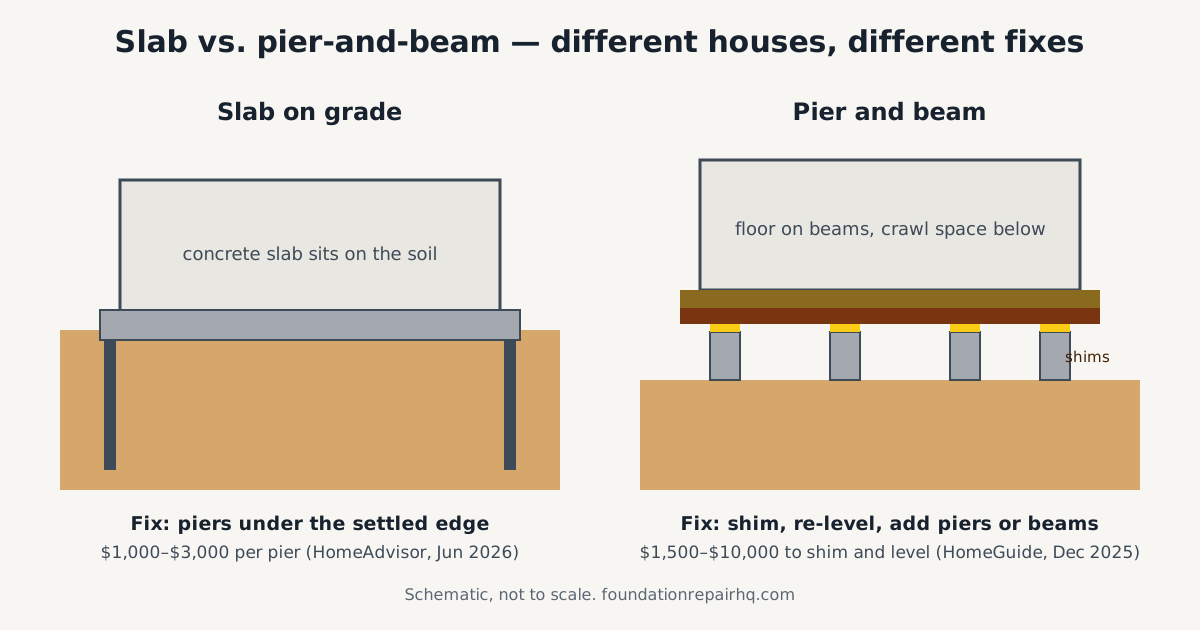
| Whole floor out on pier and beam | Shim and re-level | $1,500–$10,000 | HomeGuide, Dec 2025 |
| Moisture source | Crawl space vapor barrier / encapsulation | $1,200–$4,000 / $3,000–$15,000 | HomeGuide, 2026 |
| Foundation settled under the framing | Foundation repair | Typically $2,200–$8,200 | Fixr, Sep 2026 |
Swipe the table sideways to see every column.
Fixr puts most sagging floor repairs at $1,000–$8,500, with complex jobs above $20,000 (Fixr, Sep 2026). A repair that skips the moisture source is the one you pay for twice. Sistering a joist next to a wet crawl space only gives the rot new wood to work on.
What To Do Next
- Free: do the string test in each affected room and write the measurements down with the date. Photograph the string and tape measure at the low point.
- Free: look under the floor. In the crawl space or basement, check whether the posts touch the beam. Probe the sill and joist ends with a screwdriver (sound wood resists, rotted wood gives). Look for standing water, and photograph any notched joists.
- Free: re-measure in 3 months. A dip that hasn't changed is a stable condition. A deeper one is active.
- $340–$780: if the dip is growing, the wood is soft, or the string test shows slope instead of sag, get a structural engineer's evaluation before collecting quotes (HomeAdvisor, Jun 2026). It tells you whether this is framing, foundation, or both. See engineer vs. contractor.
- Quotes: compare on the number of joists sistered, post footings (not posts set on bare soil) and a moisture fix. The cost calculator helps size foundation work if the engineer finds settlement too.
When You Don't Need Repair
If the string test shows a dip within the code's live-load allowance of span/360 (about 0.4 inch on a 12-foot span, IRC Table R301.7), and the wood is dry and firm, with every post bearing tight and no change over 6 months, you don't have a structural problem. Save your money. Many older houses have a gentle, stable dip that has been there for decades. If it bothers you, a flooring installer can level the surface when you replace the floor covering. Spending thousands to jack a stable floor flat can crack plaster and tile that have settled into the current shape.
Related Issues to Check
- Musty smell in the house. The same crawl-space humidity that rots joists drives the musty odor upstairs. Finding the moisture source fixes both. See musty smell and moisture sources.
- Gaps between walls and the floor or ceiling. When a floor sags, interior walls built on it drop with it and open gaps at the ceiling line. That confirms which framing members have moved. See gaps between wall and floor.
- Doors that stick or swing on their own. A door frame sitting over a sagging joist racks out of square, so a door that drags at the top corner often marks the low point. See sticking doors.
Frequently Asked Questions
When should I worry about sagging floors? Worry when the dip is getting deeper, the wood is soft when probed, posts lean or have a gap at the top, or the sag is under a heavy load like a bathtub. A dip that is stable for 6 months with dry, firm wood is usually a framing quirk, not a hazard.
How expensive is it to fix sagging floors? Most sagging floor repairs cost $1,000–$8,500 (Fixr, Sep 2026). Sistering costs $150–$325 per joist, replacing a joist $500–$2,500, and replacing a main beam $2,000–$10,000. Complex jobs involving the foundation can exceed $20,000.
Are sagging floors covered by insurance? Usually not. Standard homeowners policies exclude wear and tear, rot, settling and faulty maintenance, which cover most sagging floors. The exception is sudden damage, such as a burst pipe that soaks and weakens the framing, where the resulting damage may be covered. See foundation repair insurance.
Should I buy a house with sagging floors? Yes, if an engineer finds a framing problem with a known fix and you price it into the offer. Be careful if the sag comes from foundation settlement or widespread rot. FHA guidelines list unsupported floor joists as a defect that can require repair before the loan closes (HUD 4000.1), so get an engineer's report during the option period.
What's the difference between sagging and sloping floors? A sagging floor dips in the middle between supports and is level at the walls. A sloping floor tilts the whole room one way. Sag is a framing repair from below, and slope usually means the foundation has settled.
Can sagging floors be fixed from below? Yes, almost always. Joists are sistered, new posts on proper footings are added under a girder, and the floor is raised gradually over days or weeks so plaster and tile aren't cracked by a sudden lift.
Is a sagging floor dangerous? Rarely an immediate collapse risk, but it is a loss of support that gets worse if rot or settlement continues. Keep heavy loads off a soft, actively sagging floor until it's evaluated.
Get a Professional Assessment
Whether your floor needs a few sistered joists or foundation work depends on what's under it. A free inspection tells you which, and how far the problem extends.
Last reviewed: October 2026 · Sources verified against current industry data
Sources
6 references
Cost ranges are third-party figures with the publisher and date named. They are not quotes; your price depends on an on-site assessment.
- 01Fixrfixr.com2026
- 02USDA Forest Products Laboratoryresearch.fs.usda.gov2005
- 03IRCcodes.iccsafe.org
- 04HomeGuidehomeguide.com2025
- 05HomeAdvisorhomeadvisor.com2026
- 06HUDhud.gov
Foundation repair near you
Local soil and typical cost ranges for cities where this comes up most.
Read next
- Sloping or Uneven Floors: Foundation or Normal?
- Bouncy or Springy Floors: Crawl Space Problem?
- Crawl Space Repair Cost: What's Necessary vs. Bundled Upsell
- Pier-and-Beam vs. Slab Foundation: Repair Differences Explained
- House Leveling Cost: Slab vs. Pier-and-Beam, and When You Need It
- Foundation Issues Found During Home Inspection: Buyer's Playbook