Types of Repair
Foundation Drainage and Watering: Grading, Gutters, French Drains and Soaker Hoses
Short answer
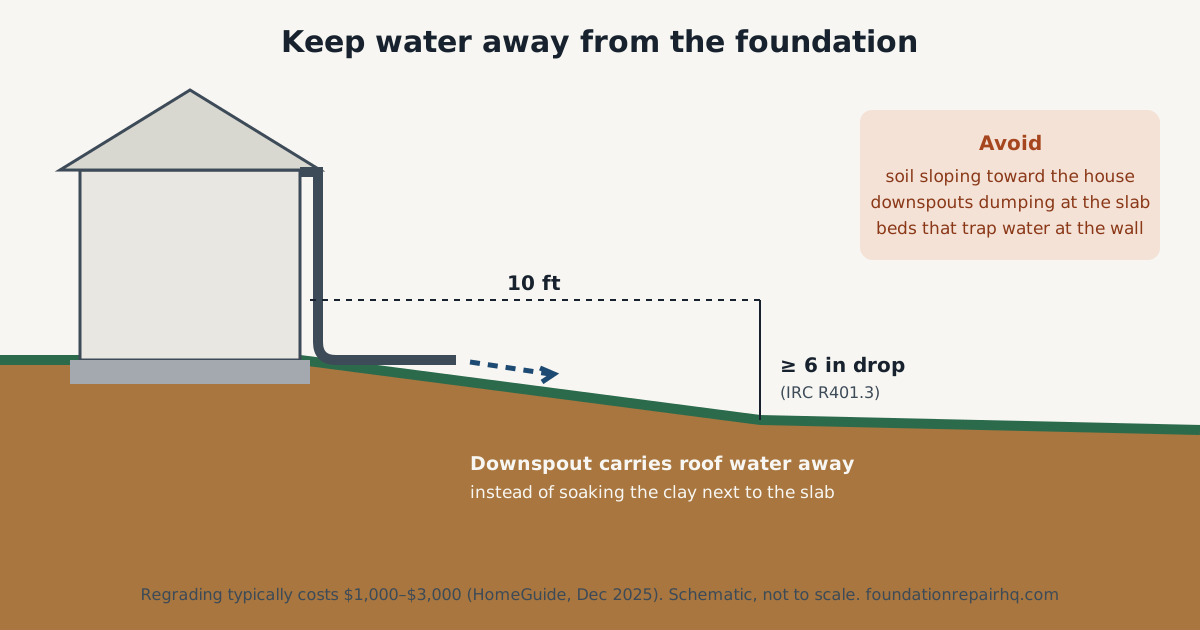
Foundation drainage means keeping the soil around your house at a steady moisture level: rain and roof water carried away, and on expansive clay, water added back during drought. Code sets the baseline: the ground must fall at least 6 inches within the first 10 feet of the foundation (IRC R401.3), and on expansive soils roof water must land at least 5 feet from foundation walls (IRC R801.3). In a Texas-style drought, Texas A&M AgriLife Extension recommends a soaker hose laid 6–8 inches from the foundation, never against it, on a low flow with no runoff (Texas A&M AgriLife, Aug 2015). Most fixes are cheap. Regrading costs $1,000–$3,000 and a French drain $1,200–$4,500 (HomeGuide, Dec 2025).
In this guide
Quick Facts
| Detail | Info |
|---|---|
| Most common cause | Roof water dumped at the foundation and soil graded flat or toward the house, so clay under one side swells while another side dries |
| Serious if | Water stands against the foundation after rain, soil pulls away from the slab in a visible gap, or new cracks open after a wet or dry season |
| Typical repair cost | Regrading $1,000–$3,000; yard drain $1,000–$4,000; French drain $1,200–$4,500; new gutters $2,200–$5,000 (HomeGuide, Dec 2025) |
| Typical repair method | Regrade to 6 inches of fall in 10 feet, extend downspouts, then add surface or French drains only where grading can't do the job |
| DIY appropriate? | Yes for downspout extensions, small grade corrections, mulch and soaker hoses; no for trenching drains near gas, water or sewer lines without calling 811 |
| Source | IRC R401.3 and R801.3; HomeGuide Dec 2025; Texas A&M AgriLife Extension Aug 2015 |
Does My Foundation Have a Drainage Problem?
Walk the outside of your house during a hard rain. If a downspout spills water at the wall, or a splash block sends it into a bed that slopes back toward the house, that is the first thing to fix. So are puddles that still sit along one side of the house the next morning.
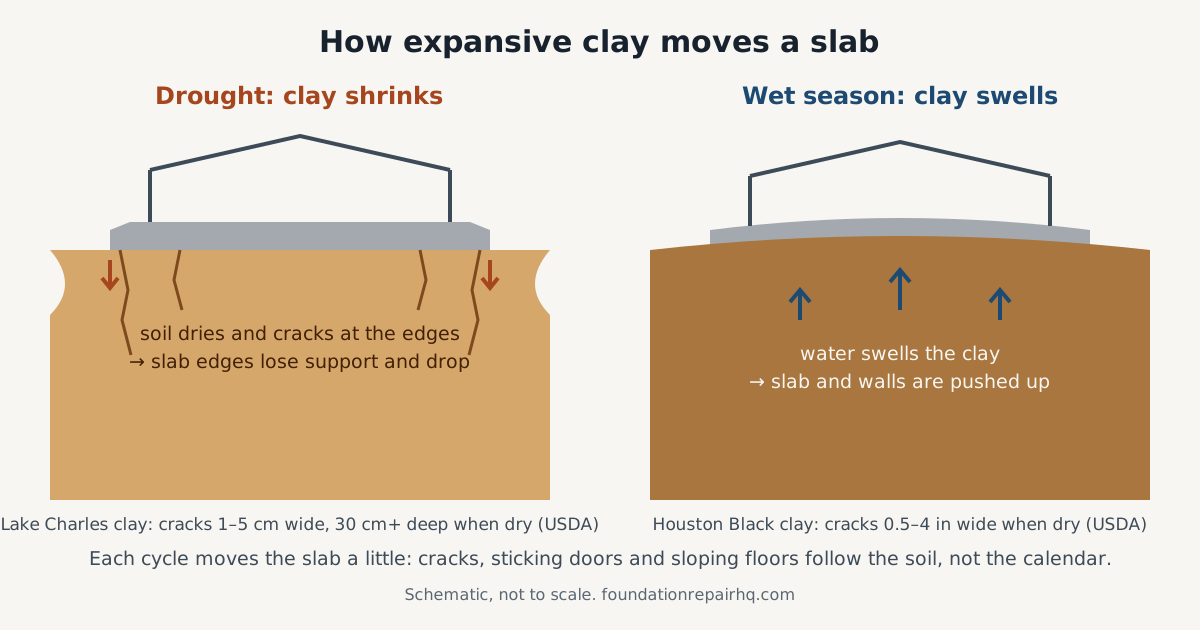
In dry weather the signs look different. On clay soil you may see a gap open between the slab edge and the dirt. You can push a finger or a pencil down into it. The lawn may crack into a pattern of plates. Around Houston, the Lake Charles clay common in the area opens cracks "1 to 5 cm wide" to a depth of 30 cm or more when dry (USDA NRCS). A gap on the sunny south and west sides and none on the shaded north side is a classic pattern.
Inside, the clues are seasonal: a door that sticks every August and frees up after the fall rains points to soil moisture swinging under part of the foundation, so the first fix is outside, not under the slab.
Foundation Drainage Fixes by Cost
| Fix | What it solves | Cost | Source |
|---|---|---|---|
| Downspout extensions, re-aimed splash blocks | Roof water landing at the wall | Usually a DIY parts purchase | — |
| Regrading around the house | Flat or reverse slope; puddles at the wall | $1,000–$3,000 | HomeGuide, Dec 2025 |
| Yard (surface) drain with catch basins | Low spots and downspouts that can't drain by grade | $1,000–$4,000 | HomeGuide, Dec 2025 |
| French drain | Groundwater or saturated soil below the surface | $1,200–$4,500 | HomeGuide, Dec 2025 |
| New gutter system | Missing or undersized gutters | $2,200–$5,000 | HomeGuide, Dec 2025 |
| Interior basement drain system | Water already coming through basement walls or floor | $4,000–$17,000 | HomeGuide, 2025 |
Swipe the table sideways to see every column.
Start at the top of that list. The University of Minnesota Extension found that surface water management alone resolves 50–80% of basement moisture problems. That means gutters, downspouts and grading, and none of them require digging a drain.
French Drain vs. Surface Drain: Which One Do You Need?
People use "French drain" for any drain, but the two systems handle different water.
- Surface (yard) drain: a grated catch basin connected to solid pipe. It collects water that is already on the surface, such as a downspout or a low spot, and carries it to the street or a lower part of the lot.
- French drain: a gravel-filled trench with perforated pipe. It collects water that has already soaked into the ground and lets it drain out underground. It's the right tool for a hillside that seeps or a yard where the water table rises after storms.
Choose a surface drain if: the water you see comes from downspouts or runs across the yard during rain, and regrading alone can't move it because of a patio, a fence line or a flat lot.
Choose a French drain if: the ground stays soggy for days after rain, water seeps from uphill, or a basement wall takes on water below grade.
Choose neither if: the grade can be corrected to 6 inches of fall in 10 feet (IRC R401.3) and the downspouts can discharge 5 feet or more from the wall (IRC R801.3).
On expansive clay a French drain must have an outlet. A gravel trench beside a slab with nowhere to drain becomes a reservoir that keeps the clay at your foundation edge wetter than everything around it.
Soaker Hose Foundation Watering: How to Do It on Clay Soil
On high-plasticity clay, foundation watering is standard extension-service advice. Texas A&M AgriLife Extension's Galveston County horticulturist puts the goal plainly: keep "the soil adjacent to the foundation at a fairly consistent moisture level throughout the year" (Texas A&M AgriLife, Aug 2015). The method:
- Lay the hose 6–8 inches from the foundation. Don't lay it right against the slab or in the gap (Texas A&M AgriLife, Aug 2015). If you have perimeter sprinklers in the beds, those work as long as you run them.
- Run it around the whole house. Water only the front yard while the back goes dry and you get part of the foundation "wet and expanded while other parts are dry and contracted." That leads to brick cracks, sticking doors and cracked tile (Texas A&M AgriLife, Aug 2015).
- Keep the flow low. Don't open the faucet all the way. Apply only what the soil absorbs "without runoff or puddling" (Texas A&M AgriLife, Aug 2015).
- Set the frequency by the soil, not the calendar. Watering "every day to start and perhaps every 2-to-3 days" once the soil moisture has stabilized (Texas A&M AgriLife, Aug 2015). Push a screwdriver into the soil a foot out from the slab. If it goes in with light pressure, the soil is moist enough.
- Mulch the beds 3–4 inches deep, but keep mulch below the top of the slab and off the brick or siding, which invites termites and ants (Texas A&M AgriLife, Aug 2015).
What NOT to do:
- Don't flood the gap with a garden hose. A heavy flow travels along soil cracks for several feet and the sudden swelling "can also cause a crack in the foundation" (Texas A&M AgriLife, Aug 2015).
- Don't over-water. Saturated clay loses 50–80% of its shear strength, and wet clay swells. Constant puddles at the slab edge are as damaging as a dry gap.
- Don't ignore your utility's rules. Dallas permits hand watering and soaker hoses on any day, while sprinklers are limited to twice a week (Dallas Water Utilities, accessed Oct 2026). Other cities restrict foundation watering in later drought stages, so check your water provider's current stage before you set a timer.
Why This Happens
Clay soil works like a sponge under your foundation, and drainage decides where the sponge is wet and where it's dry.
- Water reaches the soil unevenly. A downspout empties at one corner, a flower bed is watered on one side, and the shaded side stays damp while the west wall bakes. High-plasticity clay like the Texas Blackland Prairie's changes volume by 10–30% between wet and dry.
- The soil under one part of the foundation moves more than the rest. The wet side swells and lifts. The dry side shrinks and drops, or pulls away and leaves the slab edge unsupported. In August 2022, 68% of Texas was in extreme drought (Texas Comptroller), which is why repair calls spiked that year.
- The rigid slab can't follow both movements. It bends across the difference, and the strain shows up as cracks in brick and drywall, doors that bind, and floors that slope toward the low side.
- Poor grading: flat or reverse-sloped soil sends rain to the foundation instead of away from it.
- Short downspouts: one outlet drops a whole roof section's runoff at the footing.
- Drought shrinkage: dry clay opens gaps along the slab and leaves the edge unsupported.
- Over-watering or leaks: saturated clay swells and loses strength under one section.
- Trees and beds: roots dry one side while irrigated beds wet another.
What To Do Next
- Free: walk the house in the rain. Note every downspout outlet, puddle and spot where water runs toward the wall. Photograph them.
- Free: measure the grade. Drive a stake at the wall and one 10 feet out, run a string between them with a line level, and measure the drop. Less than 6 inches means the grade fails IRC R401.3.
- Low cost, DIY: extend every downspout so it discharges at least 5 feet from the foundation (IRC R801.3), and on clay soil start soaker-hose watering 6–8 inches from the slab during dry spells.
- $1,000–$3,000: have the perimeter regraded if your measurement is short (HomeGuide, Dec 2025).
- $1,000–$4,500: add a surface drain ($1,000–$4,000) or French drain ($1,200–$4,500) only where grading can't fix it (HomeGuide, Dec 2025). Call 811 at least 2 full business days before anyone digs.
- $340–$780: if cracks keep growing after a full wet-and-dry cycle with good drainage, get a structural engineer's evaluation (HomeAdvisor, Jun 2026). Our Texas cost guide covers what repairs cost there.
When You Don't Need Repair
If your grade already falls 6 inches in the first 10 feet and every downspout discharges at least 5 feet out, you don't need a French drain. If no water is standing against the foundation the morning after a storm, that holds even when a contractor recommends one. Save your money. A drain doesn't improve drainage that already meets code. Foundation watering is only for expansive clay. The IBC treats soil with a plasticity index under 15 as non-expansive, and on sandy or low-PI soil a soaker hose does nothing for the foundation. If the soil against your slab shows no gap and no cracks in a dry month, it's already moist enough. And seasonal hairline cracks that open in August and close by November are the soil talking, not a failing foundation. Fix the water first and monitor the crack before you pay for piers.
Related Issues to Check
- Slab leaks under the house. A leaking supply or drain line saturates clay from below, so one section heaves even when the outside drainage is perfect. Run a plumbing pressure test if one area keeps moving.
- Tree roots near the foundation. A large tree draws moisture from the soil under one side of the slab, creating a dry zone that perimeter watering can't fully offset.
- Bowing basement walls. In basement homes, saturated soil against the wall adds lateral pressure. Bad grading and short downspouts can turn a dry wall into one that bows inward. See basement wall bowing.
Frequently Asked Questions
How far should a soaker hose be from the foundation? 6–8 inches from the foundation, according to Texas A&M AgriLife Extension, and never right against the slab or down in the gap (Texas A&M AgriLife, Aug 2015). Keep the flow low enough that water soaks in without runoff or puddling.
How often should I water my foundation in a drought? Daily at first and then every 2–3 days once the soil moisture has stabilized, per Texas A&M AgriLife Extension (Aug 2015). Judge by the soil: if a screwdriver slides in easily a foot from the slab, skip a day.
Can you over-water a foundation? Yes. Saturated clay swells and loses 50–80% of its shear strength, so constant puddles at the slab edge can lift or soften that section. Steady, even moisture is the goal, not more water.
Do I need a French drain around my foundation? Only if water is getting into the ground faster than grading can shed it, such as a soggy yard, uphill seepage or a leaking basement wall. If the grade falls 6 inches in 10 feet (IRC R401.3) and downspouts discharge 5 feet out (IRC R801.3), fix those first. A French drain costs $1,200–$4,500 (HomeGuide, Dec 2025).
How much does it cost to fix drainage around a house? Regrading costs $1,000–$3,000, a yard drain $1,000–$4,000, a French drain $1,200–$4,500 and new gutters $2,200–$5,000 (HomeGuide, Dec 2025). Downspout extensions are often a DIY parts purchase and solve the most common problem.
How far should downspouts drain from the foundation? At least 5 feet on expansive or collapsible soils, under IRC R801.3, or into an approved drainage system.
Get a Professional Assessment
If your drainage meets code and the cracks still grow, the soil under your foundation has already moved. A free inspection with elevation readings tells you whether you need piers or just better water management.
Last reviewed: October 2026 · Sources verified against current industry data
Sources
7 references
Cost ranges are third-party figures with the publisher and date named. They are not quotes; your price depends on an on-site assessment.
- 01IRCcodes.iccsafe.org
- 02Texas A&M AgriLifeagrilife.org2015
- 03HomeGuidehomeguide.com2025
- 04USDA NRCSnrcs.usda.gov
- 05Dallas Water Utilitiessavedallaswater.com2026
- 06Texas Comptrollercomptroller.texas.gov
- 07HomeAdvisorhomeadvisor.com2026
Foundation repair near you
Local soil and typical cost ranges for cities where this comes up most.
- Denver, CODenver Clay$2,225–$8,133
- Frisco, TXAustin Chalk Clay$2,225–$8,133
- Austin, TXHouston Black Clay$3,822–$9,809
- Plano, TXAustin-Eagle Ford Clay$2,225–$8,133
- McKinney, TXAustin-Eagle Ford Clay$2,225–$8,133
- Georgetown, TXHouston Black Clay / Limestone$2,225–$8,133
- Round Rock, TXHouston Black Clay$2,225–$8,133
- Denton, TXEagle Ford Clay$2,225–$8,133
Read next
- Foundation Damage After Texas Drought: Timing Is Everything
- Cracks Appearing After Drought: The Clay Soil Mechanism
- New Cracks After Heavy Rain or Flooding
- Tree Roots and Foundation Damage: How Trees Really Move a Slab, and When a Root Barrier Helps
- Interior vs. Exterior Waterproofing: The Upsell You Need to Know About
- Basement Wall Bowing Inward: How Urgent Is It?