Buying & Selling
Tree Roots and Foundation Damage: How Trees Really Move a Slab, and When a Root Barrier Helps
Short answer
Tree roots rarely damage a foundation by pushing on it; they damage it indirectly, by pulling water out of clay soil so the soil shrinks and the foundation drops on the side nearest the tree. The UK's Royal Horticultural Society puts it plainly: "Tree roots are unlikely to directly penetrate sound footings," and the problem "is generally only a problem on shrinkable clay soils" (RHS, accessed Oct 2026). The fixes are cheap compared with piers: water the tree away from the house, prune it to cut its water use, or install a root barrier at least 30 inches deep (Texas A&M Extension, Mar 2002). Piers at $1,000–$3,000 each (HomeAdvisor, Jun 2026) are only for a foundation that has already dropped and is still moving.
In this guide
Quick Facts
| Detail | Info |
|---|---|
| Most common cause | Roots drying expansive clay under one side of the foundation during dry periods, so that side settles |
| Serious if | A broadleaf tree (oak, ash, pecan, hackberry) is closer than its own height on clay soil and cracks or sticking doors appear on that side (Foundation Performance Association, Mar 2003) |
| Typical repair cost | $150–$800 per tree for an arborist consultation (Today's Homeowner, Sep 2025); $1,000–$3,000 per pier if the foundation has dropped (HomeAdvisor, Jun 2026) |
| Typical repair method | Root barrier, pruning and even watering; piers only for active settlement |
| DIY appropriate? | Yes for watering and drainage; no for cutting large roots near the trunk or installing a barrier on a big tree |
| Source | Foundation Performance Association; Texas A&M Extension; RHS; ISA |
Can Tree Roots Damage My Foundation?
A large oak or pecan stands 10 or 15 feet from one corner of the house. After a long dry summer, a crack opens in the brick or the drywall on that corner, a door on that side starts to rub, and the soil along that wall pulls away from the slab, leaving a gap you can put your fingers into. In the fall rains, some of it closes again.
What you usually don't see is a root pressing on the foundation. Roots visibly lift sidewalks and driveway panels — light concrete with little load on it. A slab carries the house, and the RHS notes that roots "are unlikely to directly penetrate sound footings" (RHS, accessed Oct 2026).
If the tree was removed, the movement may run the other way: rising floors or new cracks near where it stood. And on sandy or non-expansive soil, the same tree may have no effect at all (RHS, accessed Oct 2026).
How Close Is Too Close?
Houston's Foundation Performance Association, a group of foundation engineers, publishes these checks for homes on expansive soil (Foundation Performance Association, Mar 2003):
| Tree | Keep it at least this far from the foundation | If it's closer |
|---|---|---|
| Broadleaf (oak, ash, tallow, pecan, hackberry) | A distance equal to the tree's height | Prune to hold the canopy at that size; every 2–3 years is reasonable |
| Conifer (pine) | A distance equal to the radius of its canopy | Prune to hold the canopy at that size |
| Any new tree or large shrub | Not next to the foundation at all | Remove young trees; cut shrubs back to window height |
Swipe the table sideways to see every column.
The RHS gives a similar rule for clay soils: high water-demand trees such as oak, willow and poplar can affect soil out to a distance equal to their height, and lower-demand species within about half their height (RHS, accessed Oct 2026). The FPA checks apply "even if the tree is on an adjacent property," and they don't apply where the soil "is known to be predominately non-expansive."
Timing matters too. The FPA notes that trees planted during or after construction cause subsidence, but "significant subsidence distress will usually not occur for ten to twenty years as the trees mature" (Foundation Performance Association, Mar 2003).
Root Barriers: What They Are and When They Help
A root barrier is a vertical wall of durable material buried in a trench between the tree and the foundation, after the roots crossing that line are cut. Texas A&M Extension's Horticulture Update describes the details (Texas A&M Extension, Mar 2002):
- Where: between the foundation and trees within their mature height of it, on expansive clay, placed so the barrier crosses every line from the trunk to the slab edges.
- How deep: "a depth of 30 inches minimum," and it must stick up above the soil far enough that roots can't grow over the top.
- What material: any impermeable, durable material; impermeable barriers are preferred because they also hold moisture on the house side.
- Deep-rooted trees: pecans with tap roots can dry soil deeper than 30 inches.
For a live oak 17 feet from a house, an Ask Extension expert judged a 36-inch barrier adequate, because "80-90% of your tree's root system can be found in the top 18 inches of soil," and that the gain from going to 48 inches was "probably negligible" (Ask Extension, Feb 2014). The same answer recommended leaving a few feet between the barrier and the foundation and staying at or near the tree's drip line.
Barriers aren't a guaranteed fix. The RHS warns that "in practise it is usually not feasible to install tree root barriers to sufficient depth," and that roots may "simply 'follow' and grow under a barrier" (RHS, accessed Oct 2026). Texas A&M adds that if the tree is surrounded by concrete or other buildings, cutting its roots on one side may leave it too little water to survive. We found no neutral published price for root barrier installation, so get quotes in linear feet with the depth written in.
Root Pruning, Tree Removal and the Arborist
Cutting roots to install a barrier is root pruning, and it carries a stability risk. In pull tests on young willow oaks, measurable loss of anchorage began when cuts were within three times the trunk diameter; at twice the diameter the force needed to move the trunk fell about 15%, and at one diameter about 23%. The study's recommendation: trenching "should not be closer to the trunk than a distance equal to or greater than three times the trunk diameter" (ISA Arboriculture & Urban Forestry, Mar 2008). For a tree with a 24-inch trunk, that means no trench within 6 feet.
So the first call is an ISA-certified arborist, not a foundation company: $150–$800 per tree (Today's Homeowner, Sep 2025) to learn whether the tree can lose roots on the house side.
Removal is the last resort, not the first. It averages $906 (This Old House, Mar 2026), but taking out a large tree on clay can make the soil swell back: the RHS notes that "in rare cases tree removal on such soils can lead to heave," and the FPA says trees removed at construction tend to cause heave "during the first few years" (RHS; Foundation Performance Association, Mar 2003). An engineer should weigh in before a mature tree next to a moved foundation comes down.
Why This Happens
The FPA states it directly: "The roots of trees and large plants remove large quantities of water from the soil," and where that water isn't replaced, expansive soils "may shrink... causing subsidence in the foundation" (Foundation Performance Association, Mar 2003).
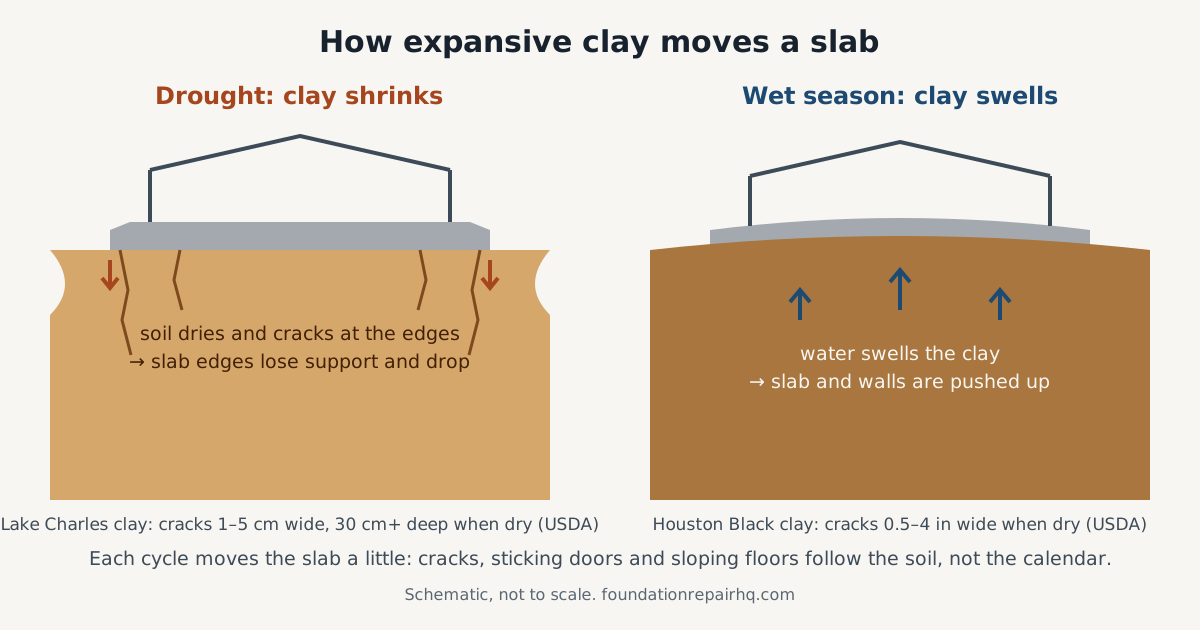
- Roots pull water from the clay under one side of the house. Demand peaks in hot, dry months.
- The clay shrinks. Texas clays shrink substantially when dry; Houston's Lake Charles series is 45–60% clay and cracks 1 to 5 cm wide when dry (USDA NRCS, rev. Mar 2016).
- That side of the foundation settles. The rest of the slab stays supported, so the house cracks at its weak points nearest the tree.
The factors that decide whether a tree is a problem:
- Soil: clay shrinks when dried; sand and gravel barely change volume.
- Species: high water-demand trees such as oak, willow and poplar reach farther than low-demand species (RHS).
- Distance: a broadleaf tree closer than its height is inside the FPA's warning zone.
- Age: young trees rarely cause distress; mature trees, 10–20 years on, do (FPA).
- Watering: a tree that gets enough water in dry spells takes less from under the slab.
- Drains: roots can enter and block leaking drains, and a leaking drain can wash out a cavity in the soil (RHS).
What To Do Next
- Free: measure each large tree's distance to the foundation and estimate its height. Photograph cracks on the tree side next to a ruler with the date.
- Free: water the tree during dry periods, but away from the house. The FPA advises applying most irrigation water "well away from the foundation to attract the tree roots in that direction," watering at least one to two feet from the foundation and lightly, and never watering directly into a gap where soil has pulled away (Foundation Performance Association, Mar 2003).
- Free: keep ground cover or mulch at least five feet out from the foundation so moisture evaporates evenly (Foundation Performance Association, Mar 2003).
- $150–$800 per tree: an ISA-certified arborist assessment before any root cutting or barrier (Today's Homeowner, Sep 2025).
- $340–$780: if cracks keep growing or floors are measurably out of level, a structural engineer's evaluation (HomeAdvisor, Jun 2026). Only then price piers with the cost calculator or our Texas and Houston cost guides.
When You Don't Need Repair
If the tree is farther from the house than its own height, or your soil is sandy or otherwise non-expansive, the tree is very unlikely to be moving your foundation — the FPA's own distance checks don't apply on non-expansive soil. Hairline cracks that open in late summer and close after fall rain are seasonal clay movement. Save your money: don't cut down a healthy shade tree or buy piers for cracks that cycle with the seasons. Water evenly, prune a close tree, re-measure in spring and fall, and act only if the movement grows year over year.
Related Issues to Check
- Gaps between interior walls and the floor or ceiling. When the tree side of a slab drops, interior walls on that side drop with it, and a gap that widens each summer is a direct record of the tree's seasonal effect.
- Shallow pressed pilings from an earlier repair. Piles that stopped on friction in the upper clay rather than at stable bearing can still sit in soil a large tree is drying, so a "repaired" corner can keep moving with it.
- Downspouts discharging on the tree side. Concentrated roof water there feeds the tree's roots toward the house and swings the soil between soaked and dry, which increases movement.
Frequently Asked Questions
Can tree roots damage a house foundation? Yes, but usually indirectly. Roots dry the clay under one side of the house, the soil shrinks and that side settles; direct root pressure rarely breaks a sound footing (RHS, accessed Oct 2026).
How far should a tree be from a house foundation? On expansive clay, a broadleaf tree such as an oak or pecan should be at least as far away as it is tall, and a pine at least the radius of its canopy (Foundation Performance Association, Mar 2003). On sandy or non-expansive soil, distance matters much less.
Do root barriers work? They can, on clay soil, if they go at least 30 inches deep and stick up above the soil (Texas A&M Extension, Mar 2002). They fail when roots grow under them or when the tree's roots go deeper than the barrier, as with tap-rooted pecans (RHS; Texas A&M Extension).
How deep should a root barrier be? At least 30 inches, according to Texas A&M Extension (Mar 2002). An Ask Extension expert judged 36 inches adequate for a live oak because 80–90% of a tree's roots are in the top 18 inches of soil (Ask Extension, Feb 2014).
Should I cut down a tree that is close to my foundation? Not as a first step. Pruning and even watering often solve it, and removing a large tree on clay can make the soil swell and heave the foundation (RHS; Foundation Performance Association, Mar 2003).
Is it safe to cut tree roots near my house? Only away from the trunk. Research on willow oaks found stability loss when cuts came within three times the trunk diameter (ISA Arboriculture & Urban Forestry, Mar 2008), so have an arborist plan any cut on a large tree.
Does homeowners insurance cover foundation damage from tree roots? Usually not; it is treated as earth movement or a maintenance issue, and TDI lists earth movement among the things most policies don't cover (TDI, Jun 2026). The narrow exception is when roots break a pipe and the sudden discharge of water damages the house.
Get a Professional Assessment
If a tree is close and your cracks are growing, the question is whether the foundation is still moving. A free inspection with floor-elevation readings gives you the baseline before anyone cuts a root.
Last reviewed: October 2026 · Sources verified against current industry data
Sources
11 references
Cost ranges are third-party figures with the publisher and date named. They are not quotes; your price depends on an on-site assessment.
- 01RHSrhs.org.uk2026
- 02HomeAdvisorhomeadvisor.com2026
- 03Foundation Performance Associationfoundationperformance.org2003
- 04Today's Homeownertodayshomeowner.com2025
- 05Ask Extensionask.extension.org2014
- 06This Old Housethisoldhouse.com2026
- 07USDA NRCSnrcs.usda.gov2016
- 08FPAfoundationperformance.org
- 09Texas A&M Extensionaggie-hort.tamu.edu2002
- 10ISA Arboriculture & Urban Forestryauf.isa-arbor.com2008
- 11TDItdi.texas.gov2026
Foundation repair near you
Local soil and typical cost ranges for cities where this comes up most.
Read next
- Cracks Appearing After Drought: The Clay Soil Mechanism
- Foundation Damage After Texas Drought: Timing Is Everything
- Foundation Drainage and Watering: Grading, Gutters, French Drains and Soaker Hoses
- Diagonal Cracks Above Doors and Windows
- How to Monitor a Foundation Crack Yourself
- Foundation Settlement Repair: Normal Settling vs. Problem Settlement, and What Fixes It